Earning Claims and Play Without Investment

A large share of searches in this category are phrased as earning rather than playing — money-earning apps, income without investment, daily earnings. This page takes those phrasings at face value and works out what they actually describe.

TurnoverHouse edgeNo-investment offersThe arithmetic
The arithmetic

What an Hour Actually Costs

Assuming a thirty-second round and a fixed stake. The expected cost is turnover multiplied by the house edge.

Rounds per hour

About 120 on a thirty-second timer, or 60 on a one-minute one.

Turnover at ₹10 a round

₹1,200 an hour on the fast timer. This is the figure the edge is applied to, not the deposit.

Expected cost

Roughly ₹36 an hour at a three per cent edge, before variance in either direction.

At ₹50 a round

₹6,000 turnover an hour and about ₹180 of expected cost, at identical odds.

Over three hours

The same figures multiplied by three, which is where most surprising session totals come from.

The direction

Negative in expectation, always, and by an amount you can calculate before you start.

The framing

Why Earning Is the Wrong Word

Not a moral point — a descriptive one, because the word implies a direction the arithmetic does not support.

What earning describes

An activity with a positive expected return, where effort or skill improves the outcome over time.

Results that accumulate in one direction as you do more of it.

vs

What this describes

A bet with a published edge against you, where nothing you do changes the expected direction of the next round.

Results that accumulate against you as you do more of it, which is the same mechanism read the other way.

More play does not produce more earnings here. It produces more turnover, and turnover is the number the house edge is applied to.

The whole argument
No-investment offers

Four Shapes, Examined

All four exist and none of them is free money, though one is genuinely free entertainment.

A demo balance

Genuinely free, genuinely unwithdrawable. Fine for learning the interface and testing a claim.

Honest

A sign-up credit

A restricted balance with a wagering multiplier. ₹51 at 30x means about ₹1,530 of turnover before anything clears.

Do the maths

Referral earning schemes

Payment for recruiting other players, which makes your income a share of what people you know lose.

Consider it

Task or watch-to-earn offers

Frequently a data-collection wrapper. The reward is small, the permission list is not, and the arithmetic is worse than it looks.

Avoid
What to notice

Five Things Worth Watching in Yourself

These are the genuinely predictive patterns in this category.

  1. Stakes rising after losses. The clearest signal that a session has changed character, and the behaviour every recovery system formalises.

  2. A second deposit in one session. The first was a decision made calmly. The second is almost always made under different conditions.

  3. Playing to recover rather than to play. The purpose has shifted from entertainment to repair, and repair is not available at these odds.

  4. Counting time rather than rounds. Minutes stretch to fit whatever is happening. A round count does not, and it maps directly onto what the session costs.

  5. Hiding the amount or the time. The most reliable indicator on this list, and it usually appears earlier than the financial signs do.

What actually reduces the cost

Three things, none of which is a prediction: a smaller stake, fewer rounds per hour, and a session length decided in advance. All three act directly on turnover, which is the only number in this category that a player fully controls.

Why the Earning Framing Is So Common

Because it matches how the search happens. People type paise kamane wala app because that is the outcome they are hoping for, and pages compete for the phrase by echoing it back. Nothing about the wording is a claim anybody has to defend, and it consistently outperforms accurate descriptions in a results page.

The framing also does real work on expectations. An app described as earning invites a comparison with work, where more effort produces more return. The comparison fails precisely at the point that matters, since more play here produces more turnover and therefore more expected cost.

The Honest Version of a Plan

Decide what an evening's entertainment is worth to you, divide by the house edge to get the turnover it supports, then divide by rounds per hour to get a stake. It takes a minute, it is the only calculation in this category that reliably does what it says, and it produces a number rather than a hope.

What the sign-up offers cost in that same currency is worked out on the ₹51 bonus page, and every guide is on the home page.
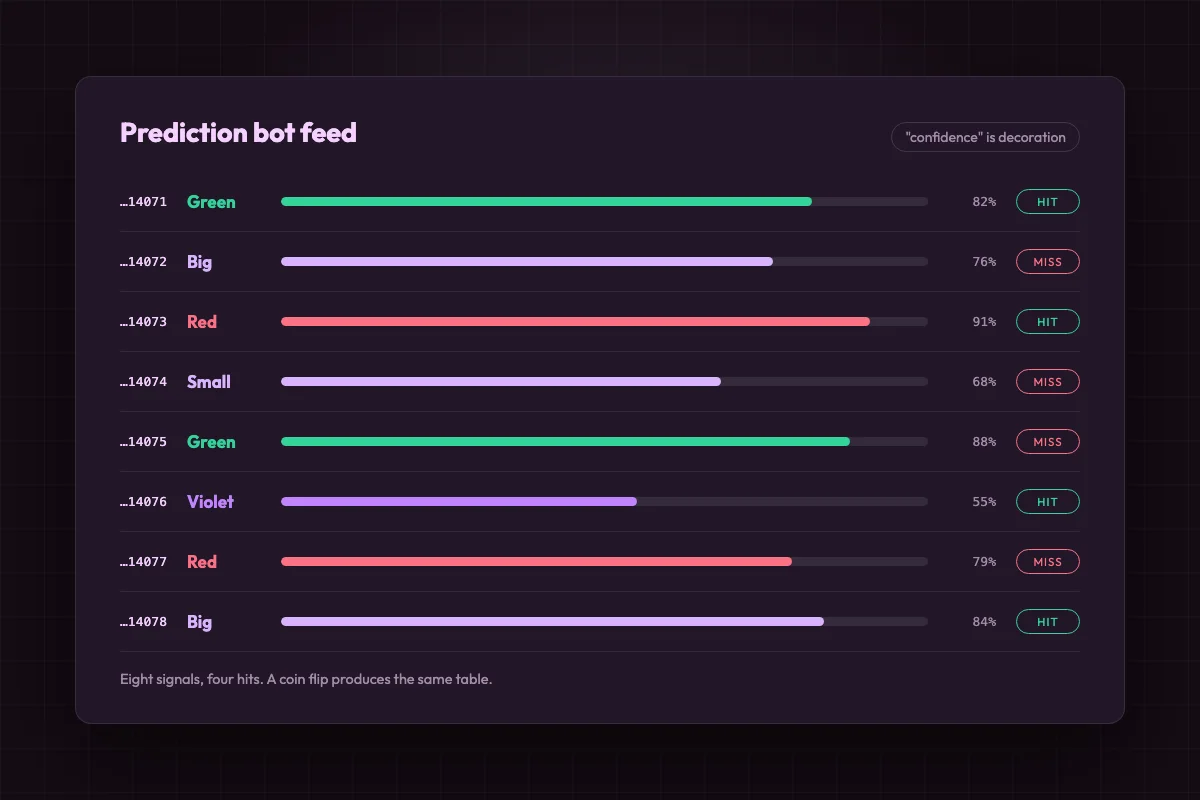
Prediction bot feed listing six signals with confidence bars and hit or miss labels beside them
FAQ

FAQ

Five questions about earning claims.

Individual sessions finish ahead often enough, but the expected direction is negative and fixed by the published edge. More play increases turnover and therefore expected cost.

Usually a demo balance or a sign-up credit. The first cannot be withdrawn at all; the second carries a wagering requirement that has to be cleared first.

They exist, and they are a share of what people you recruit lose. That is worth understanding clearly before treating it as income.

Stake times rounds per hour times about three per cent. At ₹10 a round on a thirty-second timer, roughly ₹36 an hour in expectation.

A smaller stake, fewer rounds per hour, and a session length decided before you start. All three act on turnover, which is the number you control.

This website is for informational purposes only and is not a gambling operator: we do not accept bets or payments. 18+. Gambling involves risk and may lead to addiction — please gamble responsibly. Information (bonuses/terms/licenses) may change: check current rules on the operator’s website. We are not responsible for decisions and financial losses related to the use of third-party services.