Big Small Mode in Colour Trading Apps

The same generated digit settles three different markets, and most players move between them without noticing that the arithmetic changes. This page lays them side by side: what each covers, what each pays, and which one quietly costs the most.

One digitThree marketsCoverage vs payoutThe switch after losses
The three markets

What Each Bet Covers

All settled by the same digit at the same moment. Only the coverage and the payout differ.

Big or small

Five digits each, close enough to half the outcomes. Pays a little under double, which is where the operator's share lives.

Colour

Usually two main colours covering roughly half each, with one or two digits assigned a third shade that pays far more.

Exact number

One digit out of ten, paying around nine times rather than ten. The largest share retained of the three.

Settlement

A single digit resolves all of them simultaneously. Switching markets changes your coverage and payout, never the thing being predicted.

Coverage against payout

Where the Edge Sits in Each

Approximate figures that vary a little by operator, but never in their ordering.

Big or small

About 50% coverage at roughly 1.95x. The smallest share retained per round of the three.

Smallest edge

The two main colours

Roughly half each at about 1.95x. Practically the same bet as big or small with different labels.

Smallest edge

The bonus colour

A rare digit at a high multiplier. Much wider swings for the same money.

Wider spread

Exact number

10% coverage paying about 9x. The largest share retained, and the biggest variance.

Largest edge

The move from a fifty per cent bet to a ten per cent bet after a losing run is the most expensive decision available in these apps, and the interface makes it the easiest one.

The switch that costs most
The pattern

Why the Big Payout Button Gets Pressed

Consistent enough to be worth naming, because recognising it is most of the defence.

01

A run of even-money losses

Down four or five rounds, recovery at 1.95x starts to feel slow. A nine-times payout appears to solve it in one round.

02

One large bet on a single digit

Coverage drops from half to a tenth. Expected outcome per round worsens and variance rises, both at once.

03

A rare win underwrites it

When the nine-times bet lands, it lands memorably. That one result can support months of the same decision.

04

The alternative is unglamorous

Stopping or staying flat. Neither recovers the loss, and nothing does — which is exactly why the other option is so appealing.

How apps handle it

Four Things Worth Noticing in the Interface

None is dishonest; all of them shape behaviour.

  1. The exact-number grid is usually the largest element. Ten buttons with big multipliers printed on them, positioned where a thumb naturally rests.

  2. Payout figures are shown, coverage is not. 9x is displayed prominently; one-in-ten is left for the player to work out.

  3. The history strip mixes markets. A colour strip and a size strip side by side invite pattern-reading across two views of the same digit.

  4. Auto-bet keeps a market fixed. Which is genuinely useful — it makes switching a deliberate act rather than a reflex.

Combining markets does not hedge anything

Covering both sides of the same digit pays the operator's share twice. It reduces variance and increases what the round costs, which is the opposite of a hedge.

Which Market to Use If You Are Playing

The even-money ones, at a fixed stake, if the honest answer is that you are going to play anyway. They retain the smallest share per round and swing the least, which means a session lasts longer for the same money. That is not a strategy — nothing changes the expected direction — but it does change how quickly an evening moves.

The bonus colour and the exact-number grid exist to be the thing you switch to when the even-money market has not been going your way. Knowing that in advance is most of the protection.

One Thing All Three Share

The digit arrives from the operator's servers after betting closes, whichever market you chose. No amount of moving between them brings you closer to it, and the prediction tools sold for each are working from the same absence of information.

How that digit is produced is set out on the what it is page, and every guide is on the home page.
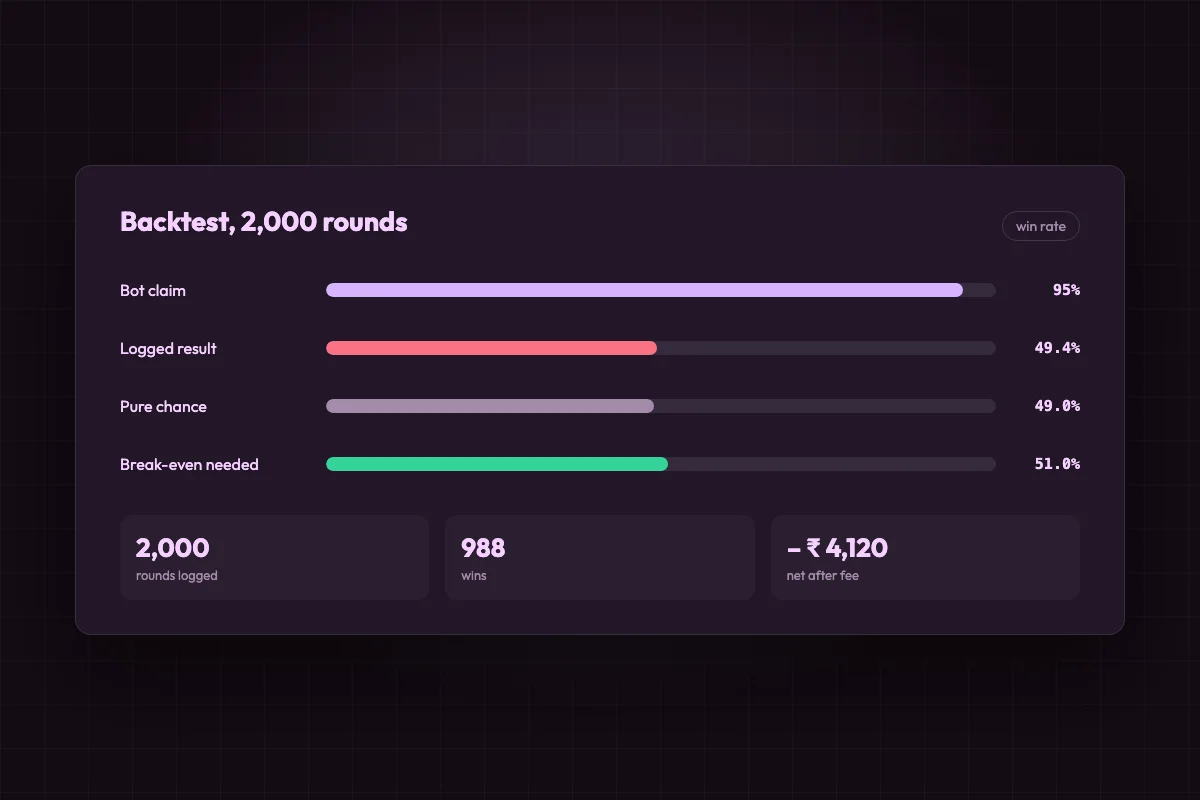
Backtest panel comparing a bot’s claimed ninety-five per cent win rate with the forty-nine per cent logged over two thousand rounds
FAQ

FAQ

Five questions about the markets.

Structurally it is the same bet with different labels — roughly half the digits either way, at nearly the same payout. The exception is the bonus colour, which is rare and pays much more.

The even-money ones. They retain the smallest share of each stake, while the exact-number bet pays about nine times for a one-in-ten chance.

Most apps allow it. Covering both sides of the same digit simply pays the operator's share twice and reduces variance rather than risk.

They perform the same everywhere, which is to say at the rate of the coverage itself. Claims tend to be highest on number bets, where an edge would be most valuable and least plausible.

Because a nine-times payout looks like a way to recover in one round. It cuts coverage from half to a tenth at the moment the stake is usually largest.

This website is for informational purposes only and is not a gambling operator: we do not accept bets or payments. 18+. Gambling involves risk and may lead to addiction — please gamble responsibly. Information (bonuses/terms/licenses) may change: check current rules on the operator’s website. We are not responsible for decisions and financial losses related to the use of third-party services.