AI Prediction Claims in Colour Trading Apps

Almost every tool launched recently describes itself as AI-powered, and some genuinely contain a model. This page is about what a model would need in order to help here, what it is actually given, and why the answer does not depend on how good the model is.

InputsTraining dataValidationThe honest use
What a model needs

Three Requirements, in Order

True of every predictive model ever built, from spam filters to weather forecasts. Nothing about the technology being new changes the list.

  1. Inputs that relate to the target. A model maps features to an outcome. Given features that carry no information, training does not fail loudly — it converges on the base rate and reports it confidently.

  2. A stable relationship over time. What was learned in training has to still hold at prediction time. In a generated sequence there is no relationship to begin with, so there is nothing to remain stable.

  3. Honest validation. Performance measured on data the model never saw, in the order it would arrive. Nearly every accuracy figure in this market is from training data or from no data at all.

  4. The result is about fifty per cent. Correctly trained on round history, a model learns that the outcomes are roughly equally likely and says so forever. That is the right answer, and it is not a product.

The data

What Is Available to Train On

Two columns and a timestamp. Everything a prediction tool can see is on this list.

The result history

Available and genuine. Also a record of independent events, which constrains nothing about the next one.

Available

Round timing

Available and uninformative. The clock is the same for a winning digit and a losing one.

Available

Bet distribution

Not published, and irrelevant anyway to a generator that runs after the lock regardless of where the money went.

Unavailable

The generator's state

The seed, the algorithm, the moment of production. The only input that would matter, on infrastructure no consumer product touches.

Unavailable

Show me a validation curve on data the model never saw, in chronological order, and I will tell you what it learned. Nobody in this market has ever produced one.

The request that ends the conversation
Reading the claims

Four Things on Every Sales Page

Here is what each is worth.

01

A rising accuracy curve

Usually a drawing. Where real, it is nearly always training accuracy — performance on the examples the model was fitted to, which can be pushed arbitrarily high.

02

A neural network diagram

Decorative. The architecture tells you nothing about inputs, training data or validation, and the same illustration appears across unrelated products.

03

“Trained on 10 million rounds”

Plausible and beside the point. Ten million samples of independent events give a precise estimate of a probability you already knew.

04

Live confidence percentages

Almost always cosmetic. A genuine confidence figure is calibrated — of the calls made at 80%, about 80% should land — and that table is never published.

The honest use

Where a Model Would Actually Help

There is real work for machine learning around these apps. None of it involves the next digit.

Detecting problem play

Long sessions, rising stakes after losses, deposits at unusual hours. Measurable, useful and entirely unmarketed.

Screening app packages

Flagging risky installs from permission manifests and signatures, before installation rather than after.

Spotting split-call channels

Clustering messages across a group to expose the practice of telling different members different things.

Estimating session cost

Turnover multiplied by the house edge, presented clearly. Arithmetic rather than prediction, and genuinely worth having.

Why the AI label works so well here

It explains the unexplainable without needing detail. A pattern-based tool invites the question of which pattern; an AI-based one answers by design, since nobody expects to understand what a network found. The label converts a gap in the argument into a feature of the technology.

On Products That Genuinely Contain a Model

Some do. A small classifier trained on round history is easy to build and will happily output varying percentages all day. Its outputs are real numbers produced by real code; what they are not is information about the next digit, because the training data contained none. That distinction is invisible from the outside, which is why the validation artefact matters more than the technology claim.

It also means the people building these are not necessarily dishonest. A team can believe the pattern-matching means something, because the market rewards confidence rather than measurement and nothing forces the comparison against a control.

One Question That Sorts the Market

Ask for held-out validation results in chronological order with losing calls included. Any team that genuinely trained a model has this file, because they could not have evaluated their own work without it. The replies we receive are consistently about proprietary methods rather than about the chart.

The protocol for producing your own figure is on the prediction apps page, and every guide is on the home page.
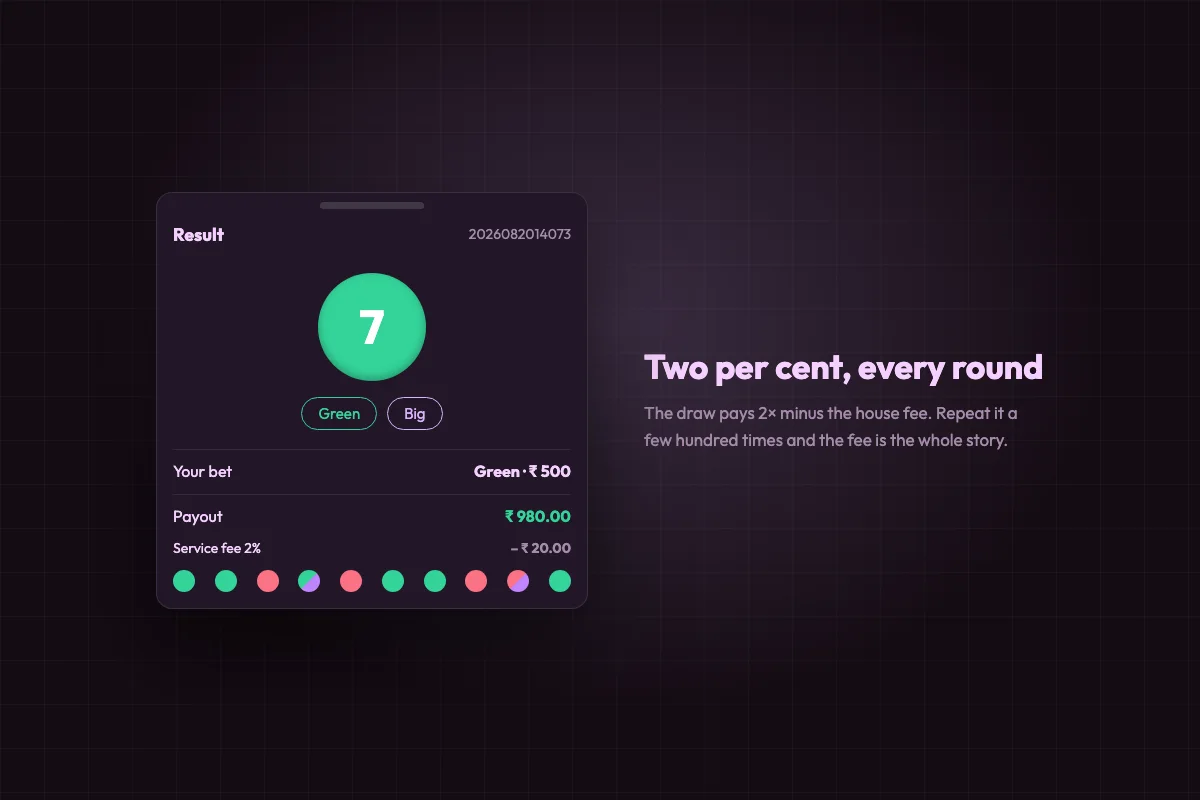
Result screen showing the drawn number seven tagged Green and Big, with the payout and the two per cent fee
FAQ

FAQ

Five questions about AI claims.

Not without access to the generator. The limit is the absence of information, not the sophistication of the method, and better models do not create data that does not exist.

Some contain a small model trained on round history. It runs, it outputs percentages, and those percentages have no relationship to the next digit.

They are numbers the interface produces. A real confidence score is calibrated against outcomes, and no product here publishes the calibration that would demonstrate it.

The chart is a record of independent events. Analysing it more cleverly does not create a dependency between rounds that was never there.

Yes — in fraud detection, app screening and responsible-play monitoring. Those uses are measurable, which is why they are not sold with accuracy percentages.

This website is for informational purposes only and is not a gambling operator: we do not accept bets or payments. 18+. Gambling involves risk and may lead to addiction — please gamble responsibly. Information (bonuses/terms/licenses) may change: check current rules on the operator’s website. We are not responsible for decisions and financial losses related to the use of third-party services.